Which AI Tool for Which Task? The Ultimate 2026 Guide
Here is the problem every professional faces in 2026: there are now eight major AI assistants, they all claim to be the best, and you do not have time to test all of them. So you default to ChatGPT for everything — writing, coding, research, brainstorming, image generation — and you quietly suspect you are leaving performance on the table.
You are.
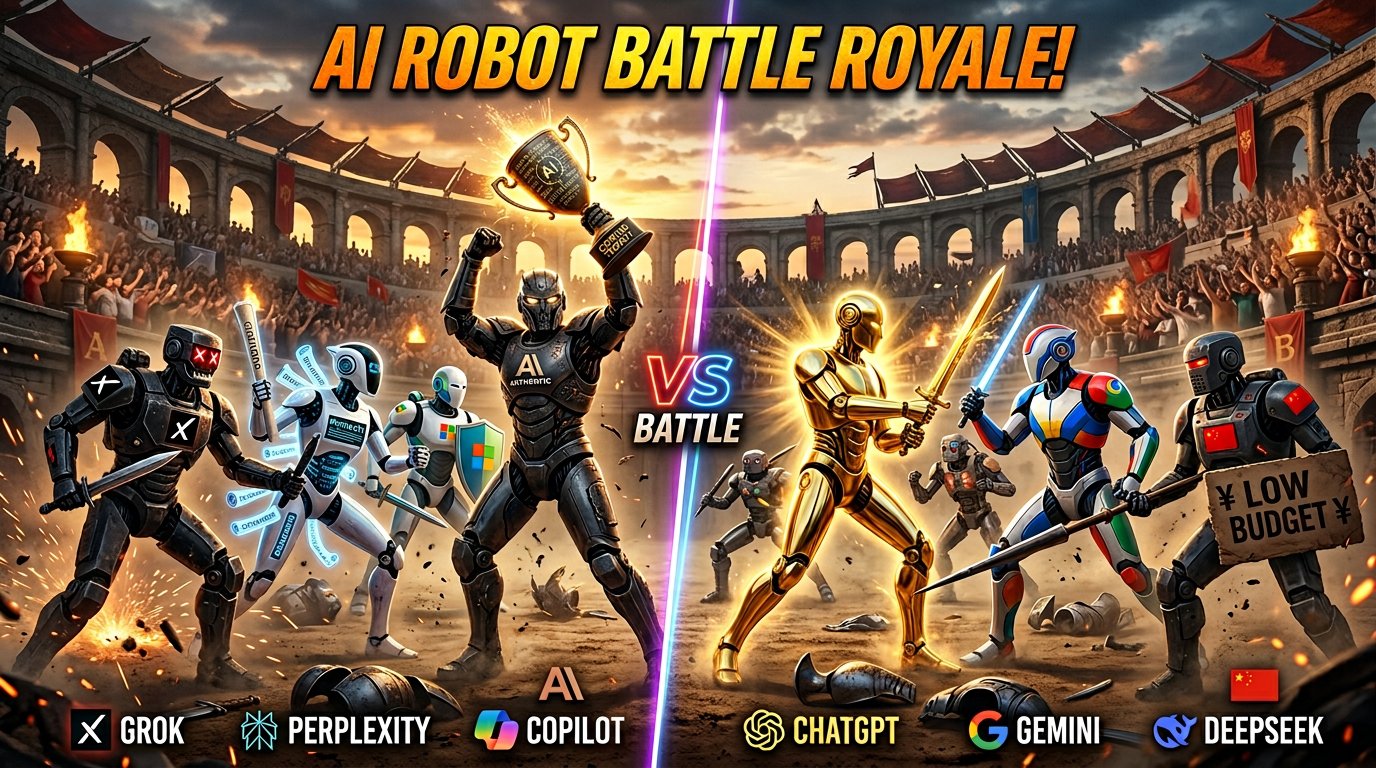
After analyzing benchmark data from SWE-bench Verified, GPQA Diamond, MMLU, HumanEval, and independent blind tests from AIMagicX, T-Minus AI, Improvado, and DataCamp, a clear picture has emerged: no single AI tool wins everything. Each model has a specific task it does better than any competitor. Using the right tool for the right job can mean the difference between production-ready code and debugging for three hours, or between a research report with verifiable citations and one with fabricated sources.
This guide matches 50 real-world tasks to the best AI tool for each, with pricing, benchmarks, and specific recommendations. Bookmark it. You will use it every day.
The Quick Reference: Best AI by Task (One Glance)
| If You Want To… | Use This | Cost | Why |
|---|---|---|---|
| Write long-form content (3,000+ words) | Claude Opus 4.8 | $20/mo Pro | Best prose quality, consistent voice across long outputs, least “AI-sounding” |
| Write code / debug / review | Claude Sonnet 4.6 | $20/mo Pro | 88.6% on SWE-bench Verified — GPT-5 scores 74.9%. Claude Code used by Stripe, GitLab, Goldman Sachs |
| Research with real citations | Perplexity Pro | $20/mo | Source-cited answers, RAG-based generation, verifiable references. No other tool does citations as well |
| Real-time news / X trends | Grok 4.3 | $30/mo SuperGrok | Only AI with native X/Twitter data access. Live social signals. No competitor has this |
| Google Workspace tasks (Docs, Sheets, Drive) | Gemini 3.0 Pro | $19.99/mo Advanced | Native Google integration. 1M-token context. Search-grounded answers |
| Microsoft Office (Word, Excel, Teams) | Microsoft Copilot | $30/user/mo | Embedded in Word, Excel, PowerPoint, Outlook. No other tool does this |
| Budget API / high-volume tasks | DeepSeek V3 | ~$0.42/1M tokens | 200x cheaper than GPT-4 Turbo. Open-weight. Strong reasoning. Data stored in China |
| Enterprise compliance / legal work | Claude Opus 4.6 | $20/mo Pro | Lowest hallucination rate. Constitutional AI training. SOC 2, SSO, audit logs |
| Creative writing / storytelling | ChatGPT GPT-5.5 | $20/mo Plus | Leads creative benchmarks. More playful, flexible style. Better at switching registers |
| Image generation | ChatGPT (DALL-E 4) | $20/mo Plus | Integrated text-to-image. Strong prompt iteration. No separate tool needed |
| Multimodal (text + image + audio + video) | Gemini 3.0 Pro | $19.99/mo | Unified text-image-code-audio reasoning. Live screen/camera input |
| Self-hosted / private AI | Llama 4 (Meta AI) | Free | Open weights. 10M-token context. Run on your own infrastructure |
| EU data sovereignty | Mistral Le Chat | Free / EUR14.99 | GDPR-compliant. EU-hosted. No US or China data storage |
| Fast everyday tasks / quick answers | Gemini Flash 2.5 | Free | ~200ms time to first token. Fast enough for real-time. 33x cheaper than GPT-4o on API |
| Learn from your own documents | NotebookLM | Free | AI-generated podcast from your docs. Strictly grounded in provided sources. No hallucination on your own content |
Deep Dive: Each Tool’s Superpower
1. ChatGPT (OpenAI GPT-5.5) — The All-Rounder
Best for: Creative writing, brainstorming, image generation, general productivity, voice mode, mixed-task workflows.
What it does better than anyone: ChatGPT is not the best at any single task except creative writing and image generation. But it is the second-best at almost everything. Its ecosystem is the broadest: DALL-E 4 for images, Canvas for collaborative editing, Voice Mode for hands-free work, Operator for browser agent tasks, Custom GPTs for specialized workflows. If you can only subscribe to one AI tool, this is still the safest bet.
Where it falls short: Coding lags behind Claude (74.9% vs 88.6% on SWE-bench). Long-form writing voice is slightly more “AI-sounding” than Claude. Research citations are less reliable than Perplexity. Real-time web browsing is slower and less complete than Gemini or Grok.
Pricing: Free (GPT-4o mini) / Plus $20/mo / Pro $200/mo. API: ~$2.50 input, ~$10 output per 1M tokens.
Verdict: The default choice when you need one tool for everything. But for specialized tasks, use the specialist.
2. Claude (Anthropic Opus 4.8 / Sonnet 4.6) — The Precision Instrument
Best for: Coding, long-form writing, enterprise compliance, legal/medical research, technical documentation, structured reasoning.
What it does better than anyone: Claude dominates coding benchmarks with 88.6% on SWE-bench Verified — the gold standard for real-world software engineering tasks. GPT-5 scores 74.9%. Claude Code, the agentic coding tool, is used by Stripe, GitLab, and Goldman Sachs for production tasks. Stripe reported Claude migrated a 50-million-line codebase in a single day.
Claude also produces the most natural, least “AI-sounding” prose of any model. For long documents where voice consistency matters — reports, essays, technical documentation, marketing copy — nothing else comes close. It has the lowest hallucination rate among frontier models, making it the safest choice for legal, medical, and compliance work where accuracy is non-negotiable.
Where it falls short: No native image generation. Real-time web browsing is weaker than ChatGPT and Gemini. Creative writing is excellent but “earnest” — consistently the tone of a thoughtful editor rather than a playful collaborator. No voice mode.
Pricing: Free (Sonnet) / Pro $20/mo / Max $100-200/mo. API: Opus ~$15 input, $75 output per 1M tokens. Sonnet ~$3 input, $15 output.
Verdict: If your work involves code or long-form writing, Claude Pro at $20/month is the single best value in AI. Most power users pair Claude (for coding/writing) with Perplexity (for research) and ChatGPT (for everything else).
3. Gemini (Google DeepMind 3.0 Pro) — The Google Power User
Best for: Google Workspace integration, multimodal tasks, large-context analysis, factual recall, everyday fast tasks.
What it does better than anyone: Gemini’s 1-million-token context window is the largest practical context among consumer AI tools. You can load an entire codebase, hundreds of documents, or hours of video/audio into a single session. Its integration with Google Drive, Docs, Gmail, and Sheets is unmatched — if you live in Google Workspace, Gemini is the obvious choice.
It also leads on graduate-level reasoning benchmarks (GPQA Diamond) and multilingual translation. The Flash variant ($0.075/1M input tokens) is the cheapest capable model on the market — 33x cheaper than GPT-4o on input — making it ideal for high-volume API workloads.
Where it falls short: Coding trails Claude and ChatGPT. Long-form writing voice drifts as the piece gets longer. Has hallucinated book titles and references in tests. Third-party integrations are limited compared to ChatGPT’s plugin ecosystem. Heavily tied to Google’s ecosystem.
Pricing: Free / Advanced $19.99/mo / Ultra $99.99-199.99/mo. API: Pro ~$1.25 input, $5 output. Flash ~$0.075 input, $0.30 output per 1M tokens.
Verdict: The smart default for Google-heavy teams. Best price-to-performance at the frontier for reasoning tasks. Not the best at any single creative or technical task, but very good at everything — and the multimodal capabilities are genuinely unique.
4. Grok (xAI 4.3) — The Real-Time Spy
Best for: Real-time news, social media trend analysis, X/Twitter research, live event monitoring, unfiltered responses.
What it does better than anyone: Grok is the only major AI assistant with native, real-time access to X (Twitter) data. It can see current posts, trending topics, and public conversations as they happen. No other model — not ChatGPT, not Claude, not Gemini — has this capability. For journalists, marketers, PR professionals, and anyone who needs to know what is happening right now, Grok is not optional. It is essential.
Grok also has a distinct personality — less filtered, more opinionated, more willing to engage with controversial topics. Its “Think” mode provides transparent step-by-step reasoning. The Heavy mode is designed for deep analytical dives.
Where it falls short: Trails Claude and ChatGPT on coding benchmarks. Smaller ecosystem and fewer integrations. Lower content moderation means higher risk of problematic outputs. Privacy concerns — X data policies apply. More expensive at $30/month than ChatGPT Plus or Claude Pro at $20/month.
Pricing: Included with X Premium+ ($22/mo) / SuperGrok $30/mo. API: ~$0.30-3.00 per 1M tokens depending on model variant.
Verdict: If you need to know what is trending on X right now, Grok is the only game in town. For everyone else, the $30 price tag is hard to justify over ChatGPT or Claude at $20.
5. Perplexity — The Research Librarian
Best for: Research with citations, fact-checking, academic work, market research, competitive analysis, anything that needs verifiable sources.
What it does better than anyone: Perplexity is not a general-purpose AI. It is a research engine. Every answer comes with citations. Every claim can be traced back to a source. The “Deep Research” mode runs multi-step research workflows, synthesizing information from dozens of sources into a coherent, cited report. For academic research, market analysis, compliance work, and any task where getting it wrong has consequences, Perplexity is the tool to use.
The “Model Council” feature lets you run the same query through multiple AI models simultaneously (GPT-5, Claude, Gemini) and compare outputs — uniquely useful for high-stakes decisions. Sonar Reasoning Pro matches frontier models on deep research tasks but adds source verification that no other tool provides.
Where it falls short: Not designed for long-form writing, coding, creative work, or general conversation. Context window is smaller than competitors. Deep Research is powerful but expensive in Pro mode. Not a replacement for a general-purpose AI assistant.
Pricing: Free (limited) / Pro $20/mo / Max $200/mo.
Verdict: The second tool every professional should have. Pair it with Claude (for writing/coding) or ChatGPT (for general use). Use Perplexity whenever the answer needs to be verifiably correct.
6. DeepSeek (V3 / R1) — The Budget Powerhouse
Best for: Cost-effective coding, reasoning-heavy tasks, budget API deployments, open-weight model experimentation, students.
What it does better than anyone: DeepSeek delivers GPT-5-class reasoning at roughly 10% of the API cost. At $0.42 per 1M output tokens, it is 200x cheaper than GPT-4 Turbo was at launch. For developers running high-volume inference, the math is compelling: DeepSeek can handle workloads that would cost thousands of dollars on OpenAI’s API for a fraction of the price.
It also leads on transparent reasoning — the step-by-step logic is fully visible, making it excellent for learning, debugging, and understanding why the model reached a particular conclusion. The open-weight models can be downloaded and run locally, making it the best option for privacy-constrained deployments where data cannot leave your infrastructure.
Where it falls short: Data is stored on servers in China. This is a dealbreaker for regulated industries, government work, healthcare, finance, and any organization with data sovereignty requirements. No native multimodal capabilities. No image generation. Smaller ecosystem and fewer integrations than Western alternatives. Fabricated statistics have been reported in marketing use cases.
Pricing: Free (unlimited chat) / API: ~$0.14 input, $0.42 output per 1M tokens.
Verdict: The best price-to-performance ratio in AI — if you can accept China-based data storage. For developers on a budget, students, and non-sensitive workloads, it is unbeatable. For enterprise or regulated work, the data sovereignty issue makes it a non-starter.
7. Microsoft Copilot — The Office Worker
Best for: Microsoft 365 users, Excel automation, Word document creation, PowerPoint generation, Outlook email drafting, Teams meeting summaries.
What it does better than anyone: Copilot is the only AI that lives inside Word, Excel, PowerPoint, Outlook, and Teams. It can generate a PowerPoint deck from a Word document. It can analyze Excel data with natural language queries. It can summarize a Teams meeting you missed. It can draft an email reply based on the thread context. No other tool — not ChatGPT, not Claude, not Gemini — can do any of this natively.
It runs on GPT-5 via OpenAI, so the underlying model quality is strong. But the real value is the integration, not the model. For organizations already paying for Microsoft 365, Copilot is a natural extension of existing workflows.
Where it falls short: Expensive at $30/user/month on top of existing Microsoft 365 subscriptions. Limited to Microsoft’s ecosystem. Not a standalone AI tool for non-Office tasks. Less flexible than ChatGPT or Claude for open-ended work.
Pricing: $30/user/month (requires Microsoft 365 subscription).
Verdict: Worth it only if your team lives in Microsoft 365 and the integration saves more than $30/month in productivity. For everyone else, ChatGPT Plus at $20/month is a better general-purpose investment.
8. Meta AI / Llama 4 — The Open-Source Option
Best for: Self-hosted deployments, privacy-first organizations, researchers, developers who need full model control.
What it does better than anyone: Llama 4 is the best open-weight model available, with a 10-million-token context window (the largest of any model) and completely free API access. You can download the weights and run it on your own infrastructure — no data ever leaves your servers. It is built into WhatsApp, Instagram, Messenger, and Threads, making it the most widely distributed AI assistant on the planet.
Where it falls short: Model quality trails frontier closed-source models (Claude, GPT-5, Gemini). Not competitive on coding benchmarks. No advanced features like voice mode, image generation, or agentic tool use in the free tier. The social media integration is convenient but raises privacy questions.
Pricing: Free (unlimited). API: $0 (open weights).
Verdict: The obvious choice when privacy, cost, or infrastructure control is the deciding factor. Not the best model, but the only one you fully control.
The Complete Task Matrix: 50 Tasks Mapped to the Best AI
| # | Task | Best Tool | Runner-Up | Why |
|---|---|---|---|---|
| 1 | Write a 5,000-word report | Claude Opus | ChatGPT | Consistent voice across long outputs. Least AI-sounding prose |
| 2 | Write a blog post (1,000 words) | ChatGPT | Claude | Faster iteration. More adaptable tone. Good at switching registers |
| 3 | Write marketing headlines | Claude | ChatGPT | Most authentic tone. Best headlines in blind tests |
| 4 | Write LinkedIn posts | Claude | DeepSeek | Natural professional voice. DeepSeek surprisingly strong on social |
| 5 | Write creative fiction | ChatGPT | Claude | Leads creative benchmarks. More playful, less “earnest” than Claude |
| 6 | Write technical documentation | Claude | ChatGPT | Structured output. Reliable handling of long technical context |
| 7 | Write a press release | Claude | ChatGPT | Professional tone. Fewer factual errors. Better structure |
| 8 | Generate Python code | Claude Sonnet | ChatGPT | 88.6% SWE-bench. Production-ready output. Used by Stripe, GitLab |
| 9 | Debug existing code | Claude Sonnet | ChatGPT | Finds more bugs. Provides more actionable fixes |
| 10 | Code review | Claude Sonnet | ChatGPT | Catches more issues. More detailed feedback |
| 11 | Build a full-stack web app | Claude Code | Lovable / Replit | Agentic coding. Multi-file. Terminal access. Production deployment |
| 12 | Generate frontend UI components | V0 (Vercel) | ChatGPT | Production-ready React/Next.js. Purpose-built for UI |
| 13 | Write SQL queries | ChatGPT | Claude | Slightly better at complex joins and optimization |
| 14 | Android app development | Gemini | ChatGPT | Integrated into Android Studio. Google-first development |
| 15 | API integration coding | Claude | ChatGPT | More reliable tool use. Better handling of API documentation |
| 16 | Research with citations | Perplexity Pro | Gemini | Source-cited answers. Verifiable. RAG-based. No hallucinations on sources |
| 17 | Market research report | Perplexity Deep Research | Claude | Multi-step research. Synthesizes dozens of sources with citations |
| 18 | Competitive analysis | Perplexity | ChatGPT | Real-time competitor data. Source-verified. No fabricated competitors |
| 19 | Academic literature review | Perplexity | NotebookLM | Citation tracking. Source verification. Academic database access |
| 20 | Fact-checking claims | Perplexity | Gemini | Every claim traced to a source. No other tool does this as well |
| 21 | Real-time news monitoring | Grok | Perplexity | Live X data. Trending topics. Breaking news before it hits Google |
| 22 | Social media trend analysis | Grok | — | Only tool with native social platform data. No alternative |
| 23 | PR crisis monitoring | Grok | Perplexity | Real-time sentiment. Live brand mentions on X. Instant alerts |
| 24 | Influencer research | Grok | — | Direct access to X profiles, follower data, engagement metrics |
| 25 | Google Sheets data analysis | Gemini | Copilot (Excel) | Native Google integration. Direct access to Drive files |
| 26 | Gmail email drafting | Gemini | Copilot (Outlook) | Context-aware. Reads thread. Drafts in Gmail directly |
| 27 | Analyze a large PDF/legal document | Gemini | Claude | 1M-token context. Can ingest entire document sets at once |
| 28 | Translate between 10+ languages | Gemini | ChatGPT | Best multilingual handling. Strong across low-resource languages |
| 29 | Generate a research podcast from PDFs | NotebookLM | — | Unique feature. AI-generated audio discussion of your documents. Free |
| 30 | Study from your own notes | NotebookLM | Claude Projects | Strictly grounded in provided sources. No hallucination on your content |
| 31 | Excel formula generation | Copilot | ChatGPT | Native Excel integration. Understands workbook context |
| 32 | PowerPoint deck from a document | Copilot | — | Only tool that does this natively. Word to PowerPoint in seconds |
| 33 | Teams meeting summarization | Copilot | — | Only tool integrated into Teams. Automatic. No setup required |
| 34 | High-volume API (1M+ calls/day) | DeepSeek | Gemini Flash | $0.42/1M tokens. 200x cheaper than GPT-4. Budget-optimized |
| 35 | Self-hosted AI deployment | Llama 4 | DeepSeek | Open weights. 10M-token context. Complete infrastructure control |
| 36 | GDPR-compliant AI | Mistral Le Chat | — | EU-hosted. GDPR-compliant. No US or China data storage |
| 37 | Legal document review | Claude | — | Lowest hallucination rate. Constitutional AI. Enterprise compliance |
| 38 | Medical/health information | Claude | — | Lowest error rate on factual claims. Always verify with official sources |
| 39 | Financial analysis | Claude | ChatGPT | More precise numerical reasoning. Fewer calculation errors |
| 40 | Brainstorming ideas | ChatGPT | Claude | Faster iteration. More divergent thinking. Better at “yes, and” |
| 41 | Image generation / DALL-E | ChatGPT | Gemini | Integrated DALL-E 4. Best prompt iteration. No separate tool needed |
| 42 | Voice conversation / hands-free | ChatGPT | Gemini | Best voice mode. Most natural conversation flow. Multi-accent |
| 43 | Analyze images / charts / screenshots | ChatGPT | Claude | Best vision model for charts, diagrams, OCR-heavy screenshots |
| 44 | Analyze video content | Gemini | — | Unified text-image-video-audio reasoning. Live camera input |
| 45 | Compare AI outputs (multi-model) | Poe | Perplexity | Routes tasks across GPT, Claude, Gemini. Cross-model synthesis |
| 46 | Build a custom AI agent | Claude Code / MCP | ChatGPT Operator | Strongest agentic capabilities. Tool use. Multi-step autonomous execution |
| 47 | Landing page creation | Claude | Gemini | Implementation-ready HTML output. Clean, production-quality code |
| 48 | Campaign planning / strategy | DeepSeek + Claude | Gemini | DeepSeek for CRO recommendations. Claude for execution |
| 49 | Privacy-first browsing | Brave Leo | — | Browser-native. Privacy-first. BYOM (bring your own model) |
| 50 | Learn to code / tutorials | ChatGPT | Claude | Better at explaining concepts. More patient. Simpler language |
The Power User Stack: What the Pros Actually Use
After analyzing how professional developers, writers, marketers, and researchers combine these tools, a pattern emerges. The most common power user stack in 2026 is:
Claude Pro ($20/mo) — for coding, long-form writing, and any task where output quality matters
Perplexity Pro ($20/mo) — for research, citations, and fact-checking
ChatGPT Free — for image generation, voice mode, and quick tasks
Grok (X Premium+) — for real-time news and social media monitoring
Total: $40-60/month for a complete professional AI toolkit.
If you can only afford one: ChatGPT Plus at $20/month is the best general-purpose choice. It is not the best at anything except creative writing and image generation, but it is the second-best at nearly everything.
If your work involves code: Claude Pro at $20/month is non-negotiable. The 88.6% vs 74.9% SWE-bench gap between Claude and GPT-5 is the difference between code that runs and code you debug for three hours.
If your work involves research: Perplexity Pro at $20/month plus Claude Pro is the combination used by journalists, analysts, and academics. Perplexity finds the truth. Claude writes about it.
The Cost Comparison: What You Actually Pay
| Tool | Free Tier | Paid Tier | API (per 1M input tokens) | API (per 1M output tokens) |
|---|---|---|---|---|
| ChatGPT (GPT-5.5) | Yes (GPT-4o mini) | $20/mo Plus | $2.50 | $10.00 |
| Claude (Opus 4.8) | Yes (Sonnet) | $20/mo Pro | $15.00 | $75.00 |
| Claude (Sonnet 4.6) | Yes (Sonnet) | $20/mo Pro | $3.00 | $15.00 |
| Gemini 2.5 Pro | Yes | $19.99/mo | $1.25 | $5.00 |
| Gemini Flash 2.5 | Yes | — | $0.075 | $0.30 |
| Grok 4.3 | Limited | $30/mo SuperGrok | $3.00 | $15.00 |
| Grok Mini | Limited | — | $0.30 | $1.50 |
| DeepSeek V3 | Yes (unlimited) | Free | $0.14 | $0.42 |
| Perplexity Pro | Yes (limited) | $20/mo | — | — |
| Microsoft Copilot | Yes (basic) | $30/user/mo | — | — |
| Llama 4 (Meta AI) | Yes (unlimited) | Free | $0 (open weights) | $0 (open weights) |
| Mistral Le Chat | Yes (generous) | EUR14.99/mo | Varies | Varies |
| NotebookLM | Yes (unlimited) | Free | — | — |
Frequently Asked Questions
Which AI is best overall in 2026?
There is no single best AI. Claude leads on coding (88.6% SWE-bench) and long-form writing. ChatGPT leads on creative writing, image generation, and ecosystem breadth. Gemini leads on multimodal tasks and Google integration. Perplexity leads on research with citations. Grok is the only tool for real-time X/Twitter data. The practical answer is to use two or three tools in combination. If forced to choose one general-purpose tool, ChatGPT Plus at $20/month is the safest default because it is the second-best at nearly everything.
Is Claude really better than ChatGPT for coding?
Yes, by a significant margin. Claude Sonnet 4.6 scores 88.6% on SWE-bench Verified (the benchmark for solving real GitHub issues autonomously), while GPT-5 scores 74.9%. Claude Code is used by Stripe, GitLab, and Goldman Sachs for production software engineering. For code generation, debugging, and code review, Claude is the stronger choice. ChatGPT remains competitive and is often preferred for explaining coding concepts to beginners.
Which AI tool is completely free?
Several tools offer genuinely free tiers: DeepSeek offers unlimited free chat (data stored in China), Meta AI (Llama 4) is completely free across WhatsApp, Instagram, and Facebook, NotebookLM is entirely free from Google, and all major tools (ChatGPT, Claude, Gemini, Perplexity, Grok) offer free tiers with limitations on model quality or usage volume. For zero-cost high-quality AI, DeepSeek is the best option if data sovereignty is not a concern. For zero-cost with privacy, Llama 4 via Meta AI is the best option.
Which AI should I use for my business?
It depends on your primary use case. For marketing/content teams: Claude Pro for writing, Perplexity Pro for research. For development teams: Claude Pro for coding, ChatGPT Plus for general tasks. For Google Workspace organizations: Gemini Advanced. For Microsoft 365 organizations: Copilot. For regulated industries (legal, healthcare, finance): Claude Pro with its lower hallucination rate and enterprise compliance features. Most businesses benefit from subscribing to two tools: one specialist for the primary task (Claude for coding/writing, or Perplexity for research) and ChatGPT Plus as the general-purpose backup.
Is DeepSeek safe to use for business?
DeepSeek stores user data on servers in China. This creates compliance risks for regulated industries (finance, healthcare, legal), government work, and any organization subject to GDPR, SOC 2, or similar data protection frameworks. For personal use, non-sensitive projects, and cost-conscious development, DeepSeek’s price-to-performance ratio is unmatched. For enterprise use, the data sovereignty issue makes it a non-starter for most Western organizations. If you need low-cost AI with Western data storage, Gemini Flash ($0.075/1M input tokens) is the best alternative.
What is the cheapest AI API for high-volume use?
Gemini Flash 2.5 at $0.075 per million input tokens and $0.30 per million output tokens is the cheapest capable model available — 33x cheaper than GPT-4o on input. DeepSeek V3 at $0.14 input and $0.42 output is slightly more expensive but offers stronger reasoning. For 1 million API calls per day, the cost difference is dramatic: roughly $75/day on Gemini Flash vs $2,500/day on GPT-4o.
Do I need to pay for multiple AI tools?
Most professionals benefit from two paid subscriptions: one specialist tool for their primary task (Claude Pro for coding/writing at $20/month, or Perplexity Pro for research at $20/month) plus one general-purpose tool for everything else (ChatGPT Plus at $20/month). Total: $40/month for a complete professional toolkit. Free tiers of Gemini, Grok, DeepSeek, and NotebookLM can supplement specific needs without additional cost. Power users often add Grok (for real-time news) or Perplexity Pro (for research) for a total of $40-60/month.
Disclaimer
This article is based on publicly available benchmark data, independent model evaluations, API pricing pages, and product documentation as of July 12, 2026. Benchmark scores (SWE-bench Verified, GPQA Diamond, MMLU, HumanEval) are drawn from published results by Anthropic, OpenAI, Google DeepMind, xAI, and independent evaluators including AIMagicX, T-Minus AI, Improvado, DataCamp, and eesel. Pricing is based on publicly listed rates and is subject to change. Tool capabilities and model versions evolve rapidly; verify current performance for your specific use case before making purchasing decisions. This article does not constitute an endorsement of any AI tool or provider. All trademarks belong to their respective owners.