AI Bias in Recruitment: What HR Teams Must Know Before Automating Hiring
99% of Fortune 500 companies now use AI in their hiring processes. Lawsuits, EEOC enforcement actions, and peer-reviewed research reveal a consistent finding: automated hiring tools are systematically disadvantaging protected classes. Legal exposure is no longer theoretical.
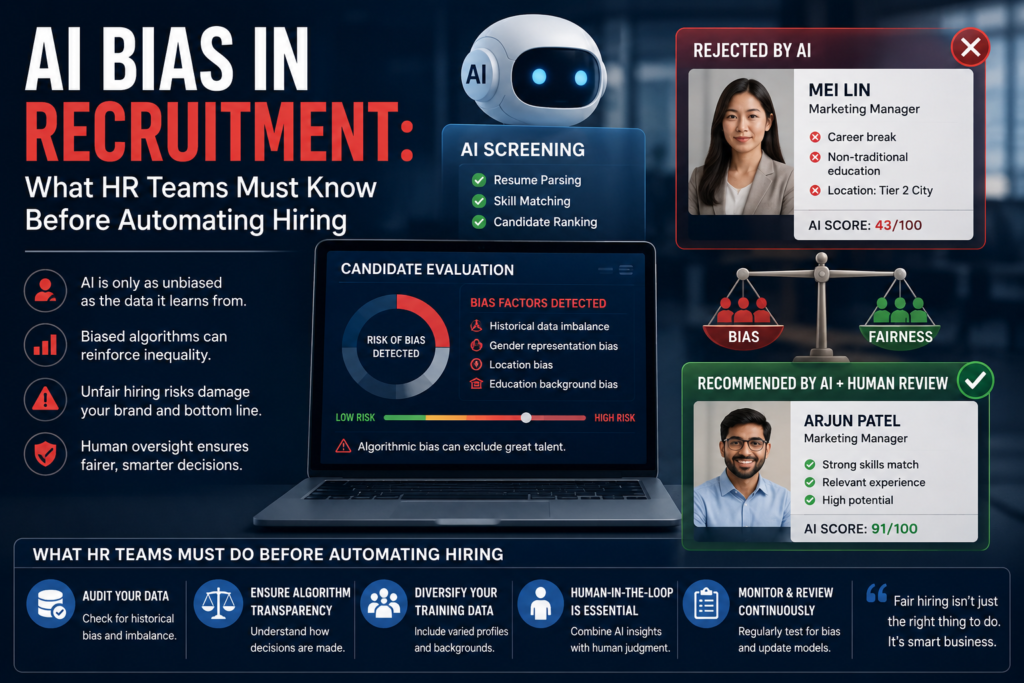
Research Desk · May 2026 · Sources: University of Washington, Fortune, EEOC, ScienceDirect, Sanford Heisler Sharp McKnight
| 99% Fortune 500 companies using AI in hiring (2024) 85.1% Cases where AI favored white-associated names over others 61% AI tools that replicated discrimination when trained on biased data |
The promise was efficiency and objectivity: remove human subjectivity from the hiring process, let algorithms evaluate hundreds of candidates at once, and surface the most qualified people faster. The reality, documented now across dozens of peer-reviewed studies, legal filings, and regulatory actions, is more complicated. AI hiring tools have not eliminated bias. In many cases, they have automated it, accelerated it, and made it significantly harder to detect or appeal.
By 2024, 492 of the Fortune 500 companies were using applicant tracking systems powered by AI to screen, rank, and filter job candidates. The HR technology market is expected to expand from $43.7 billion in 2025 to $81.8 billion by 2032. This growth is substantially outpacing both the regulation and the auditing frameworks needed to catch systematic discrimination before it harms candidates at scale.
What the Evidence Shows
The University of Washington Information School published a landmark study analyzing AI-assisted resume screenings across nine occupations using 500 applications. The findings were stark: the technology favored white-associated names in 85.1% of cases. Female-associated names were favored in only 11.1% of cases. In some occupational settings, Black male applicants were disadvantaged compared to white male counterparts with identical qualifications in up to 100% of cases — meaning the algorithm never once favored an equally qualified Black male candidate over a white male one in those contexts.
A May 2025 study published through VoxDev found that AI hiring tools systematically favored female applicants over Black male applicants with identical qualifications — an entirely different directional bias from the Washington findings. The combination of these two studies illustrates a critical truth: AI bias is not monolithic, consistent, or predictable. It emerges differently across different tools, different training datasets, and different occupational contexts.
A 2022 analysis found that 61% of AI recruitment tools trained on biased historical data replicated discriminatory hiring patterns. The mechanism is straightforward: if an organization historically hired predominantly white, male candidates — even for reasons that were themselves shaped by structural inequity — any AI system trained on that organization’s hiring history will learn to replicate those patterns as success signals. Historical success and historical bias are often encoded in the same data.
“There’s no defense saying ‘AI did it.’ If AI did it, it’s the same as the employer did it. — Labor lawyer Guy Brenner”
Who Is Being Harmed — and How
The categories of harm are widening beyond race and gender. Peer-reviewed research published in ScienceDirect in October 2025 found that platforms including HireVue have been shown to unintentionally disadvantage neurodiverse individuals — particularly those with autism or ADHD — by scoring them lower due to non-traditional response patterns. Automated voice and facial analysis tools fail to accommodate speech differences or non-standard facial expressions, leading to unjustified exclusions from hiring pools entirely.
AI hiring systems also frequently fail to recognize gender identities outside the male-female binary, leading to errors in applicant rankings or the automatic disqualification of candidates who do not fit conventional gender categories. In some tools, simply entering demographic information triggers filtering that candidates cannot see, cannot understand, and cannot appeal. The opacity of these systems is itself a form of structural harm.
HR leaders at mid-sized tech companies report a troubling pattern of internal awareness without action: internal data shows Black candidates moving through initial AI screening at about 60% the rate of white candidates with similar qualifications. The problem is known. The accountability structures to force action before a lawsuit compels it are frequently absent.
Landmark Legal Cases and Regulatory Actions
August 2023 — EEOC v. iTutorGroup (First-of-Its-Kind Settlement)
The EEOC settled the first AI employment discrimination lawsuit in U.S. history against iTutorGroup, which had programmed its recruitment software to automatically reject applicants based on age — women over 55 and men over 60. EEOC Chair Charlotte Burrows stated that ’employers cannot rely on AI to make employment decisions that discriminate against applicants on the basis of protected characteristics.’ The settlement established that automated discrimination carries the same legal liability as deliberate human discrimination.
February 2024 — Mobley v. Workday (Class Action Lawsuit)
Derek Mobley filed a class action lawsuit against Workday, Inc., alleging the company’s AI-enabled applicant screening system engaged in a systematic ‘pattern and practice’ of discrimination based on race, age, and disability. The algorithm is alleged to have automatically screened and ranked job applicants in ways that consistently disadvantaged protected classes. In May 2025, the case reached a significant legal milestone. Potential exposure runs to millions of dollars and could set precedent establishing employer liability when third-party AI vendors are involved.
March 2025 — ACLU Colorado v. HireVue / Intuit
The ACLU Colorado filed a complaint with the EEOC and the Colorado Civil Rights Division against Intuit, Inc. and its AI vendor HireVue on behalf of an Indigenous and deaf job applicant. HireVue’s AI-powered video interview system assessed the candidate in ways alleged to have systematically disadvantaged her based on her disabilities and communication style — scoring her lower due to non-standard speech patterns and facial expressions that the system was not designed to accommodate.
October 2025 — Stanford Research on Disparate Impact
Stanford researchers published findings that AI resume-screening tools exhibit significant and measurable disparate impact across racial and gender categories. The research is now being cited directly in EEOC guidance and state legislation as empirical support for mandatory bias auditing requirements.
The Regulatory Landscape
New York City’s Local Law 144 — effective July 2023 — requires annual independent bias audits for automated employment decision tools and public reporting of the results. Employers must give candidates ten business days’ notice before AI evaluation. However, a December 2025 audit found significant compliance gaps. An amendment taking effect January 2026 allows discrimination victims to sue directly rather than relying solely on regulatory enforcement.
California finalized regulations in October 2025 clarifying how existing anti-discrimination law applies to AI hiring tools. Colorado’s AI Act (SB 24-205), effective June 2026, will require developers and users of AI hiring tools to use ‘reasonable care’ to prevent algorithmic discrimination, with a cure period through June 2027. The measure faced political headwinds including a December 2025 executive order tasking the DOJ to challenge it as burdensome.
Europe has moved more decisively. The EU AI Act, effective August 1, 2024, classifies HR tools as ‘high-risk’ AI systems subject to mandatory conformity assessments, risk documentation, and ongoing monitoring. Crucially, emotion recognition in job interviews became illegal under the Act on February 2, 2025 — the first such prohibition of a specific AI hiring capability anywhere in the world.
What HR Teams Must Do Now
- Conduct a bias audit of every AI tool in your recruitment stack. Ask vendors for demographic parity data across race, gender, age, and disability status — if they cannot provide it, that is itself a significant red flag warranting immediate review.
- Review training data. If your hiring history has demographic imbalances — and most organizations’ do — any AI trained on it will encode those imbalances as predictive success signals.
- Ensure human review is meaningful, not cosmetic. Rubber-stamping algorithmic recommendations provides no legal protection if the algorithm itself discriminates. The human must be genuinely empowered to override.
- Comply proactively with NYC Local Law 144, Colorado’s SB 24-205 (effective June 2026), and EU AI Act requirements if operating in those jurisdictions. Do not wait for enforcement to force audits.
- Establish an internal AI ethics review process for any new hiring technology, including tools supplied by third-party vendors. Courts are increasingly holding employers fully responsible for tools they deploy, regardless of the vendor relationship.
- Audit facial analysis and voice assessment tools specifically. These are at highest risk of disadvantaging neurodiverse candidates, disabled candidates, and those with non-standard speech patterns. The EU has banned emotion recognition in interviews; U.S. law is moving in the same direction.
- Document everything. Create a clear audit trail of how AI tools were selected, how they were tested for bias before deployment, and how human overrides are recorded. This documentation is your primary defense in litigation.
Sources: University of Washington Information School resume screening study; Fortune, July 2025; Sanford Heisler Sharp McKnight, December 2025; ScienceDirect (AI Bias in HRM Systems), October 2025; VoxDev, May 2025; Responsible AI Labs, November 2025; EEOC case filings and settlement documents; EU AI Act regulatory text; Colorado SB 24-205; NYC Local Law 144; arXiv gender bias in recruiting, 2025.